
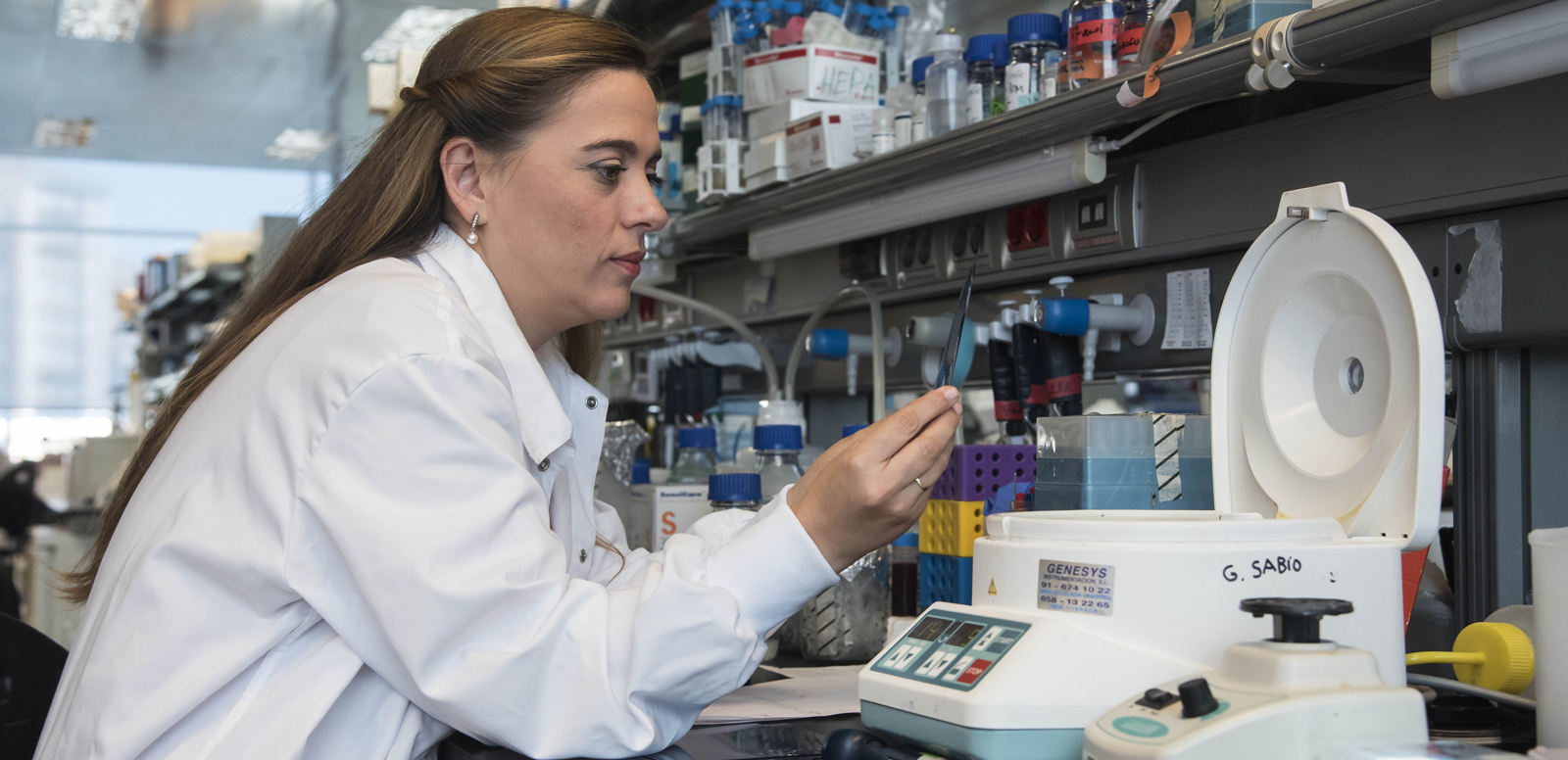
Guadalupe Sabio, holder of a 2017 Leonardo Grant, makes the EMBO list of top young research talents
Guadalupe Sabio, holder of a 2017 Leonardo Grant in Biomedicine, was elected to the list of 28 young research talents decided annually by the European Molecular Biology Organization (EMBO).
3 November, 2017
A 2017 Leonardo Grant awardee in the Biomedicine category, Sabio has been included on the European Molecular Biology Organization’s list of 28 outstanding young investigators. To appear on this list, drawn up annually and with tenure lasting three years, candidates must submit an application and get through a panel interview. Inclusion entitles them to join a program where they can choose a mentor from among EMBO’s membership to guide them in their careers over the next three years.
The project which earned Sabio her Leonardo Grant will examine whether inhibition of p38 kinase, shown to have increased levels among liver cancer patients, could reduce the spread of this type of tumor. “If our tests in mice are successful, the results could quickly reach patients, since our first attempts will be with inhibitors already approved and marketed for other kinds of indication. Otherwise, we will have to explore improvements in these inhibitors that work in our treatment of hepatic cancer,” Sabio explains.
For Guadalupe Sabio, the Leonardo Grant has meant not having to shut down her project. “It came at the perfect moment, just when my European funding ran out,” the investigator remarks. “The Leonardo Grant doesn’t just mean I can go on with my research, it is also a recognition that my work is of value. It is truly an honor.” The grants are important, she believes, because they place scientific research in a public light and can by this means encourage people to invest in science.”
Regarding her election to the EMBO list, Sabio is especially enthused by the mentoring available to recent entrants. “When pursuing a science career, it’s imperative to know what steps to take at each precise moment, and this system is a great help,” she explains. She has not yet decided who to choose as mentor, but knows she will be looking for dedication as well as scientific quality.
And there are yet more benefits to being on the list. In their second year, the young investigators receive a 15,000 euros award. They can also apply for smaller grants of up to 10,000 euros and enjoying funding and other support to speak at and attend conferences.